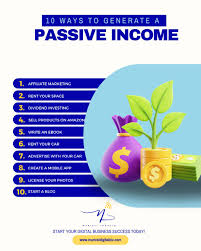
Creating a high-yield passive income plan involves smart idea generation, strategic setup, and consistent evaluation. Focus on building assets that work for you over time, rather than trading time for money.
Understanding Passive Income
Passive income means earning money without actively working for it every single day. Think of it like planting a tree. You do the work of planting and watering it at first.
Later, it grows and gives you fruit without you needing to tend to it constantly. That fruit is your passive income.
It’s different from active income. Active income is what you get from a job or freelancing. You show up, you do the work, and you get paid.
If you stop working, the money stops coming. Passive income keeps flowing, even when you’re sleeping, on vacation, or spending time with family.
Why is this so important to so many people? It offers a way to gain financial freedom. It can help you pay off debt faster.
It can fund your dreams, like traveling the world or starting a new business. It also builds a safety net for unexpected events.
There are many ways to earn passive income. Some require a lot of money to start. Others need a lot of time and effort upfront.
The key is finding what fits your skills, your resources, and your goals. We’ll explore different avenues so you can see what might be a good fit for you.
My First Passive Income Mishap
I remember my first big idea. It was about five years ago. I was tired of my 9-to-5 grind.
I’d read a lot about real estate investing. So, I found a small duplex and bought it. I thought, “Great!
I’ll rent it out and collect checks.” Easy, right? Wrong.
The reality hit fast. Tenants called at all hours with plumbing issues. The lawn needed mowing.
The furnace broke in January. I spent more time fixing things and dealing with calls than I did relaxing. It felt more like a second, very demanding job.
I was stressed and exhausted. This wasn’t the passive income I’d dreamed of. It showed me that “passive” doesn’t mean “no work ever.” It means the type of work shifts.
Passive Income Ideas: Quick Scan
Rentals: Properties, equipment, even parking spaces.
Investments: Stocks, bonds, mutual funds, real estate investment trusts (REITs).
Digital Products: Ebooks, online courses, stock photos, software.
Royalties: Books, music, patents.
Affiliate Marketing: Promoting other people’s products.
Peer-to-Peer Lending: Loaning money to individuals or businesses.
Brainstorming Your High-Yield Ideas
So, how do you find an idea that actually gives you a good return? It starts with understanding what “high-yield” means for you. It’s not just about making a lot of money.
It’s about making money that is a good return on the time and money you put in.
Think about your skills. What are you good at? What do you enjoy doing?
Do you have a knack for writing, design, or coding? Are you organized? Do you love teaching others?
Your existing talents are a great starting point.
Consider your interests. What topics do you know a lot about? What do you love learning about?
Passion makes the upfront work much easier. If you’re genuinely interested in a subject, you’re more likely to stick with it.
Look at the market. What do people need or want? Are there problems you can solve?
What are people willing to pay for? This is where research comes in. Use tools like Google Trends or keyword research tools to see what’s popular.
Think about assets. An asset is something that holds or grows in value. It’s something that can generate income for you.
This could be a physical asset, like a property, or a digital asset, like an online course.
Don’t limit yourself to just one idea. The best passive income plans often have multiple streams. This spreads risk and increases your overall earnings.
Exploring Different Passive Income Avenues
Let’s dive deeper into some popular passive income streams. Each has its own pros and cons.
Real Estate Investing
As I learned, this isn’t always passive. But it can be with the right approach. You can buy rental properties.
You can also invest in Real Estate Investment Trusts (REITs). REITs are like mutual funds for real estate. You buy shares, and you get a portion of the rental income.
This is much more passive.
With physical properties, you can hire a property manager. They handle tenant issues, maintenance, and rent collection. This costs money, but it makes the income truly passive.
The key is buying properties in good locations with strong rental demand.
Real Estate: Key Considerations
Upfront Cost: Often high. Down payments, closing costs.
Time Investment: High if self-managed. Moderate with a manager.
Potential Return: Can be very high through appreciation and rent.
Risk: Vacancies, property damage, market downturns.
Liquidity: Low. Selling property takes time.
Investing in the Stock Market
This is a classic passive income method. You buy stocks of companies that pay dividends. Dividends are a share of the company’s profits given to shareholders.
You can also invest in dividend-paying ETFs or mutual funds. These are baskets of stocks, offering diversification.
This requires capital to start. The amount you earn depends on how much you invest and the dividend yield. It’s important to do your research.
Understand the companies you’re investing in. Diversification is crucial to reduce risk. You don’t want all your eggs in one basket.
Some people also make money from stock price increases (capital gains). But for passive income, dividends are the focus. This method is highly passive once you set up your portfolio.
Regular review is needed, but you don’t actively trade daily.
Creating and Selling Digital Products
This is where I’ve found great success. If you have knowledge or a skill, you can package it. Think about ebooks, online courses, templates, or printables.
You create it once, and you can sell it over and over again.
For example, I love baking. I created a detailed ebook on sourdough bread making. I spent weeks writing, testing recipes, and taking photos.
I put it on my website and a few online marketplaces. Once it’s listed, people can buy it anytime. My role then is marketing and customer service (answering simple questions).
The upfront effort can be significant. You need to create high-quality content. Then, you need to market it effectively.
But once it’s out there, it can generate income for years. The profit margins are often very high because there are no physical goods to produce or ship.
Digital Products: Your Creation Station
Ebooks: Share your knowledge in a written format.
Online Courses: Teach a skill with videos, lessons, and resources.
Templates: Offer pre-designed documents, graphics, or plans.
Stock Photos/Videos: If you’re a photographer, sell your work.
Software/Apps: Develop a tool that solves a problem.
Affiliate Marketing
This involves promoting other companies’ products or services. You earn a commission when someone buys through your unique link. You don’t need to create your own product.
You just need an audience.
This works well if you have a blog, a YouTube channel, or a strong social media following. You can write reviews, create tutorials, or recommend products you genuinely use and love. When your audience trusts your recommendation, they click your link.
The key is authenticity. Only promote products you believe in. If you just push anything for a commission, you’ll lose your audience’s trust.
It takes time to build an audience and establish that trust. But once you have it, affiliate marketing can be a steady income stream.
For example, a fitness blogger might link to their favorite workout gear. A tech reviewer might link to gadgets they’ve tested. The affiliate network handles the tracking and payment.
You just focus on creating valuable content that naturally includes recommendations.
Creating a Niche Website or Blog
This is similar to affiliate marketing but broader. You build a website around a specific topic. You provide valuable content – articles, guides, reviews.
You can then monetize it in several ways:
- Advertising: Display ads through networks like Google AdSense.
- Affiliate Marketing: As discussed above.
- Selling Your Own Products: Ebooks, courses, etc.
- Sponsored Posts: Companies pay you to write about their product.
This takes time to build traffic. You need to consistently publish good content and work on SEO (Search Engine Optimization). SEO helps your site rank higher in search results.
The goal is to attract organic traffic from search engines. Once your site has authority and traffic, it can become a very profitable passive income asset.
I started a small blog about indoor gardening a few years back. I wrote about plant care, best soil types, and troubleshooting common problems. I used affiliate links for gardening tools and seeds.
I also sold a small ebook on growing herbs indoors. It took about a year to see any real income, but now it generates a nice monthly amount with minimal ongoing effort.
Niche Website: Path to Income
Topic Selection: Choose something you know and enjoy.
Content Creation: Write high-quality, helpful articles consistently.
SEO: Optimize your content to rank in search engines.
Monetization: Add ads, affiliate links, or sell products.
Patience: It takes time to build traffic and income.
Lending Money
You can earn passive income by lending money. This can be through peer-to-peer (P2P) lending platforms. These platforms connect individuals or small businesses needing loans with investors like you.
You earn interest on the money you lend.
This is a higher-risk option. There’s always a chance the borrower might not repay. Diversifying your loans across many borrowers is crucial.
You can start with small amounts on each loan. The platforms usually have risk assessment tools to help you choose.
Another form is lending to businesses through crowdfunding platforms. Again, research is key. Understand the business and its ability to repay.
This method requires capital, and the returns depend on the interest rates and the risk of default.
Royalties from Creative Works
If you’re a writer, musician, or inventor, you can earn royalties. This happens when your work is used or sold. For example, if you write a book, you get paid each time it’s sold.
If you compose music that’s played publicly or licensed for commercials, you earn royalties.
Patents on inventions also generate royalties if others manufacture and sell your invention. This is a form of passive income that rewards creativity and innovation. The upfront effort is the creation itself.
Once it’s published, sold, or licensed, income can flow in.
The challenge here is creating something valuable and marketable. It requires talent, skill, and sometimes a bit of luck. But for those who succeed, it can be a very rewarding and passive income stream.
Royalties: Rewarding Creativity
Books: Earn per sale through publishers or self-publishing.
Music: Royalties from streaming, radio play, and licensing.
Photography: Licensing fees for image use.
Patents: Licensing fees for your invention.
Developing Your Passive Income Plan
Once you have a few ideas that excite you, it’s time to create a plan. This is where the “high-yield” aspect really comes into play. You need to think strategically.
Step 1: Choose Your Niche and Idea
Based on your skills, interests, and market research, pick one or two primary ideas to focus on. Don’t try to do everything at once. Starting small and doing it well is better than doing many things poorly.
For instance, if you’re great at graphic design and have always wanted to write, you might choose to create and sell design templates (like social media post templates) and also write a short ebook on design principles.
Step 2: Assess Required Resources
What do you need to get started? This includes:
- Capital: How much money do you need for initial investments? (e.g., buying stocks, developing a course, purchasing a property).
- Time: How much time can you dedicate upfront to build the asset? (e.g., writing an ebook, building a website, researching stocks).
- Skills: Do you have the necessary skills, or do you need to learn them or outsource them?
Be realistic. If you have very little capital, focusing on digital products or affiliate marketing might be better than real estate. If you have limited time, perhaps investing in index funds is a good start.
Step 3: Create a Timeline
When do you want to see results? Break down your goal into smaller, manageable steps. For example, if you’re creating an online course:
- Month 1: Outline course content, research tools.
- Month 2: Record videos, write lesson text.
- Month 3: Edit videos, design supporting materials.
- Month 4: Upload to platform, set up sales page, start marketing.
This timeline helps you stay on track and motivated. It also helps you manage expectations. Passive income rarely happens overnight.
Step 4: Set Financial Goals
How much passive income do you aim to generate? Be specific. Is it $500 a month?
$2,000 a month? Or enough to replace your full-time income?
Calculate what this means in terms of your chosen passive income stream. If you’re investing in dividend stocks, how much capital do you need to generate your target income? If you’re selling ebooks, how many do you need to sell at your price point?
Goal Setting: What to Aim For
SMART Goals: Specific, Measurable, Achievable, Relevant, Time-bound.
Income Target: Define monthly or annual passive income goal.
Investment Amount: Determine capital needed if investing.
Sales Volume: Estimate product sales needed for income goals.
Step 5: Build Your Asset
This is the core work phase. You’ll be creating, investing, or setting up whatever generates your passive income. Focus on quality.
A poorly made product or a weak investment will not yield good results.
For a digital product, this means excellent content, good design, and a user-friendly experience. For investments, it means thorough research and a diversified portfolio. For a website, it means valuable articles that truly help readers.
Step 6: Automate and Systemize
The goal is to make it passive. Look for ways to automate tasks. Use tools for scheduling social media posts, autoresponders for emails, or payment processing systems.
If you’re in real estate, hire a property manager. If you have a website, consider hiring a virtual assistant for content updates or customer service.
This phase is crucial for truly making your income passive. It involves setting up systems that run with minimal intervention from you.
Step 7: Monitor and Adjust
Passive income assets aren’t “set it and forget it” forever. You need to monitor their performance. Are your investments doing well?
Is your website traffic growing? Are your digital products selling? Are there new market trends you need to consider?
Make adjustments as needed. This might mean rebalancing your investment portfolio, updating your ebook, or tweaking your marketing strategy for your online course. Stay informed about your chosen field.
Automation Tools: Your Efficiency Boosters
Email Marketing: Mailchimp, ConvertKit, ActiveCampaign.
Social Media Scheduling: Buffer, Hootsuite, Later.
Website Platforms: WordPress, Shopify, Teachable.
Investment Platforms: Vanguard, Fidelity, Robinhood.
Project Management: Asana, Trello, Monday.com.
Real-World Context and Scenarios
Let’s look at how this plays out in everyday life. Imagine Sarah, a graphic designer. She’s tired of client work dictating her schedule.
Her Goal: Earn $1,000 per month in passive income within two years.
Her Plan:
- Idea: Create and sell digital design templates (social media graphics, presentation slides, resume templates) on Etsy and her own website.
- Resources: She has design skills and a computer. She’ll need to invest about $200 for premium design software plugins and Etsy listing fees. She can dedicate 10 hours per week for the first six months.
- Timeline:
- Months 1-3: Design 20 template kits, set up Etsy shop and website landing page.
- Months 4-6: Create marketing materials, run small social media ads, and learn basic SEO for Etsy.
- Months 7-12: Monitor sales, gather customer feedback, design 15 new kits based on popular demand.
- Months 13-24: Expand product line, explore affiliate marketing for design tools, potentially hire a virtual assistant for customer service.
- Financial Target: To make $1,000/month, assuming an average profit of $5 per template kit, she needs to sell 200 kits a month. This seems achievable with a growing product catalog and marketing.
- Automation: She uses Etsy’s automatic delivery. She sets up an email autoresponder for website visitors.
- Monitoring: She checks her Etsy stats weekly and her website analytics monthly.
Now consider Mark, a recent college graduate with some savings but limited time due to his demanding entry-level job.
His Goal: Grow his savings and generate some passive income to supplement his salary.
His Plan:
- Idea: Invest in low-cost index funds and ETFs.
- Resources: He has $5,000 saved. He can add $200 per month from his salary. He has time to research investment platforms and different fund types.
- Timeline:
- Month 1: Research brokerage accounts, choose a platform (like Vanguard or Fidelity), and select a diversified S&P 500 index fund.
- Ongoing: Set up automatic monthly contributions ($200).
- Annually: Review portfolio performance and rebalance if necessary.
- Financial Target: He aims for an average annual return of 7-10% over the long term. His initial $5,000 plus monthly contributions will grow steadily.
- Automation: His monthly contributions are automated.
- Monitoring: He checks his account balance quarterly. He stays updated on general market news but avoids day-to-day trading.
Scenario Comparison: Sarah vs. Mark
Sarah (Digital Products):
- Effort: High upfront creative and marketing work.
- Capital: Low ($200 initial, then ongoing marketing budget).
- Return: Potentially high profit margins, scalable.
- Patience: Needs 1-2 years to build significant income.
Mark (Index Funds):
- Effort: Low, mostly research and setup.
- Capital: Moderate ($5,000 initial, ongoing contributions).
- Return: Moderate, compounding over time.
- Patience: Long-term growth, income is more gradual.
What This Means For You
This journey is personal. What works for Sarah might not work for Mark. The most important thing is to start.
Don’t get stuck in analysis paralysis.
When is your passive income idea normal? It’s normal when you’ve done your research, set realistic goals, and put in the necessary upfront work. It’s normal when the income stream is sustainable and doesn’t require constant, active intervention once established.
When should you worry? You should worry if:
- You’re not seeing any progress after a significant amount of time and effort.
- The income stream is highly volatile or requires constant firefighting.
- You’ve invested a lot of money or time and are seeing no return.
- The business model is no longer viable due to market changes.
A simple check is to ask: “If I took a two-week vacation right now, would this income stream completely disappear?” If the answer is yes, it’s not truly passive yet. You need to continue building systems or outsourcing tasks.
Another check is to compare your return on investment (ROI) for both time and money. Are you getting a good return for the effort you’re putting in? For example, if you spend 40 hours a week to make $100, that’s not a high-yield activity.
It’s better to use that time to build an asset that pays you over time.
Quick Fixes and Tips for Success
Here are some actionable tips to help you along the way:
- Start Small: Don’t try to launch five passive income streams at once. Pick one, master it, then expand.
- Focus on Value: Whether it’s a product, service, or content, it must provide real value to your audience or customers.
- Be Patient: Passive income takes time to build. Don’t get discouraged by slow early results.
- Learn Continuously: Markets change. Stay updated on your niche and strategies for passive income.
- Outsource Wisely: As your income grows, delegate tasks that you don’t enjoy or aren’t good at. This frees you up for higher-level strategy.
- Reinvest Profits: Use some of your passive income to invest back into your existing assets or to create new ones. This accelerates growth.
- Track Everything: Keep records of your income, expenses, and time invested. This helps you understand what’s working.
Top Tips for High-Yield Passive Income
Be Realistic: Understand that “passive” doesn’t mean “no effort.”
Focus on Assets: Build things that generate income independently.
Diversify: Don’t rely on a single source of passive income.
Leverage Technology: Use automation tools to save time.
Stay Consistent: Regular effort, especially early on, pays off.
Frequently Asked Questions
What is the difference between passive income and portfolio income?
Passive income generally refers to income generated from a business or enterprise in which you are not actively involved. Portfolio income, on the other hand, comes from investments like stocks, bonds, and other securities. While both are often considered passive, passive income typically involves more active creation or management upfront.
How much money do I need to start generating passive income?
The amount varies greatly. For some ideas like dividend stock investing, you’ll need capital. For others, like creating an ebook or starting a blog, your main investment is time and effort.
You can start with very little money by focusing on digital products or affiliate marketing.
Is it possible to live solely off passive income?
Yes, it is possible, but it requires significant upfront investment of time and/or money to build multiple substantial income streams. Many people aim to eventually
How long does it take to see passive income results?
This depends heavily on the method. Investing in stocks can start paying dividends quickly, but significant growth takes years. Building a website or creating a digital product can take months or even a year or more to generate substantial income.
Patience is key.
Are there any tax implications for passive income?
Yes, passive income is taxable. The specific tax rules depend on your location and the type of passive income you earn. It’s advisable to consult with a tax professional to understand your obligations.
What are the biggest mistakes people make with passive income?
Common mistakes include expecting overnight success, not putting in enough upfront work, investing in things they don’t understand, failing to diversify, and not reinvesting profits. Also, not treating it like a real business can lead to failure.
Conclusion
Creating a high-yield passive income plan is a journey, not a sprint. It requires thoughtful planning, smart choices, and persistent effort upfront. By understanding your options, setting clear goals, and focusing on building valuable assets, you can steadily build income streams that work for you.
The freedom and financial security that come with it are well worth the initial dedication.